Profit Guard reads your whole shop through Etsy's official API: every listing, every order of the last 12 months, your shipping profiles. It takes off every Etsy fee, adds your own costs, and gives each listing a verdict, Renew, Fix, or Kill, with the reason in numbers.
Scan my shop with Profit Guard: $37Nothing changes in your shop unless you approve it · One-time payment · 30-day money-back guarantee
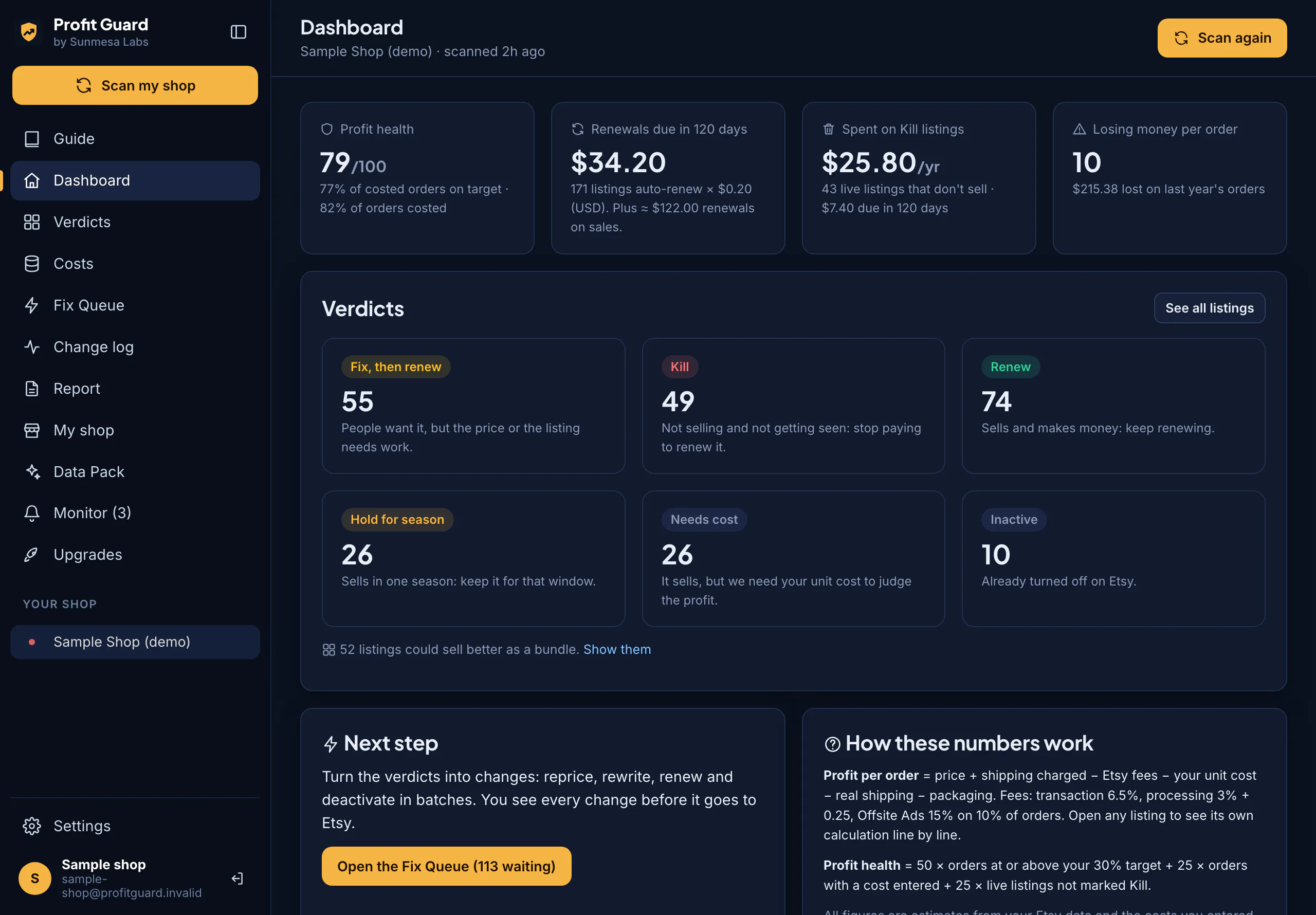

Source: sample scan of the Profit Guard demo shop (240 made-up listings, US, USD), the same shop new members see inside the app. *If each listing sold as many orders at the new price as last year, which it may not.
1:15 · The real app on our sample shop (240 made-up listings), the same one new members see inside.
Every Etsy listing costs $0.20 to publish. Etsy charges it again every 4 months when the listing auto-renews, and again each time it sells while stock is left. It looks like nothing. Multiply it.
Now the real question: how many of those 1,000 listings haven't sold once in the last year? In our sample scan, 47 of the 49 Kill listings had zero orders in 12 months. 37 of them were set to auto-renew within 120 days.
Most sellers never do this sum, because Etsy never shows it to you as one number. You see "$0.20" in your payment account, line after line, mixed in with sales. You don't see which listing each line belongs to, or whether that listing has earned a cent since the last time you paid for it.
So the shop grows. 300 listings, 600, 1,200. Old variations, test products, last year's trend, the design that never took off. Each one keeps renewing quietly, and the bill grows with the catalog, not with sales.
The renewal fee is the leak you can see. The bigger one is hidden inside your best sellers.
A worked example anyone can check with a calculator: an $18 item with $4.50 shipping, sold by a US shop. Fee rates as published by Etsy at the time of writing.
| Item price | $18.00 | |
| Shipping the buyer pays | $4.50 | |
| Buyer pays | $22.50 | |
| Transaction fee | 6.5% × $22.50, on the shipping too | −$1.46 |
| Payment processing | 3% × $22.50 + $0.25 (US) | −$0.93 |
| Offsite Ads, if the order came from one | 15% × $22.50 (12% for shops over $10k a year) | −$3.38 |
| Currency conversion, if your bank currency differs | 2.5% × $22.50 | −$0.56 |
| Your costs | unit cost $7.20 + real shipping $5.10 + packaging $0.60 | −$12.90 |
| You keep | on an Offsite Ads order in another currency | $3.28 |
That's exactly how it happens, and it has a name: the free-shipping trap. Etsy pushes sellers toward free shipping, so the postage quietly moves out of your margin. A cheap item with free shipping sells well, so you never look at it. In our sample shop, a $12.24 necklace with free shipping sold 14 times last year. Its unit cost is $8.81 and its real postage $4.60. After Etsy's fees, it lost $3.03 on every normal order and $4.87 on every Offsite Ads order. The more it sells, the more it costs.
Another one, a $13.47 necklace, sold 37 times. It makes $2.44 on a normal order and $0.42 when the sale comes through Offsite Ads. If the seller also pays currency conversion, it makes $0.08. Busy and popular, it works for almost nothing.
You can't see this in Shop Manager, because Etsy shows revenue, not profit. To see it, you'd have to put every order's fees and your own costs into a spreadsheet, listing by listing. That's the job Profit Guard does.
Necklace figures from the sample scan (made-up listings, 10% of orders through Offsite Ads). Small shops sell fewer orders, so check yours: the scan shows the loss per order and the orders behind it.
Three steps, about 15 minutes the first time, most of it the scan running on its own.
Log in to Etsy and allow access. No password is shared. Profit Guard reads your shop's country and currency and fills in your fee rates for you to check.
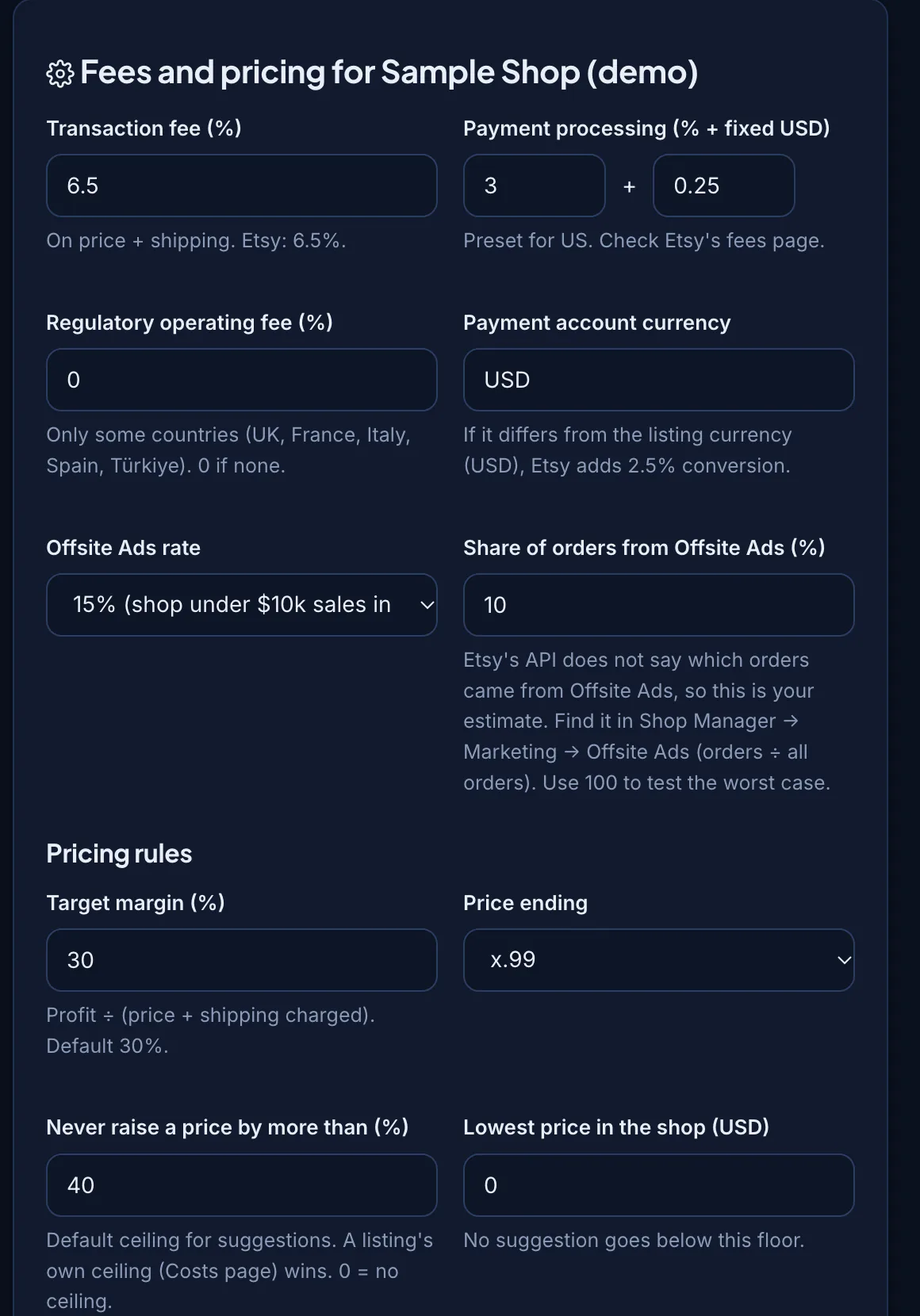
The scan reads every listing (active, expired, sold out, inactive), your shipping profiles and 12 months of orders. Then you add what each item costs you, best sellers first. Type costs in one by one or upload a CSV.
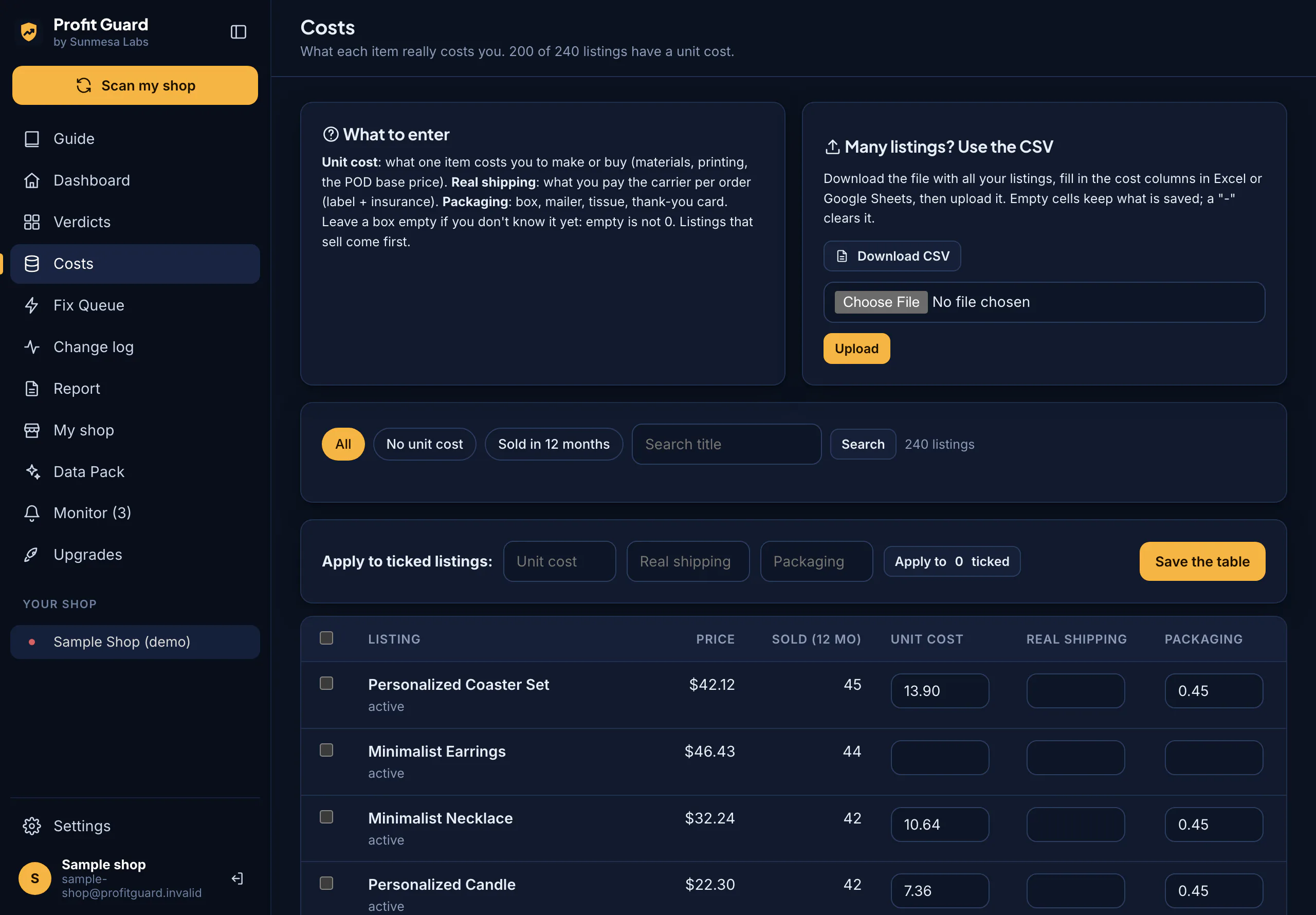
Every listing gets a verdict: Renew / Fix then renew / Kill / Hold for season / Needs cost. Each one comes with the reason in numbers, plus a suggested price where the margin is short. Work through the PDF report and checklist yourself, or let Autopilot apply what you approve.
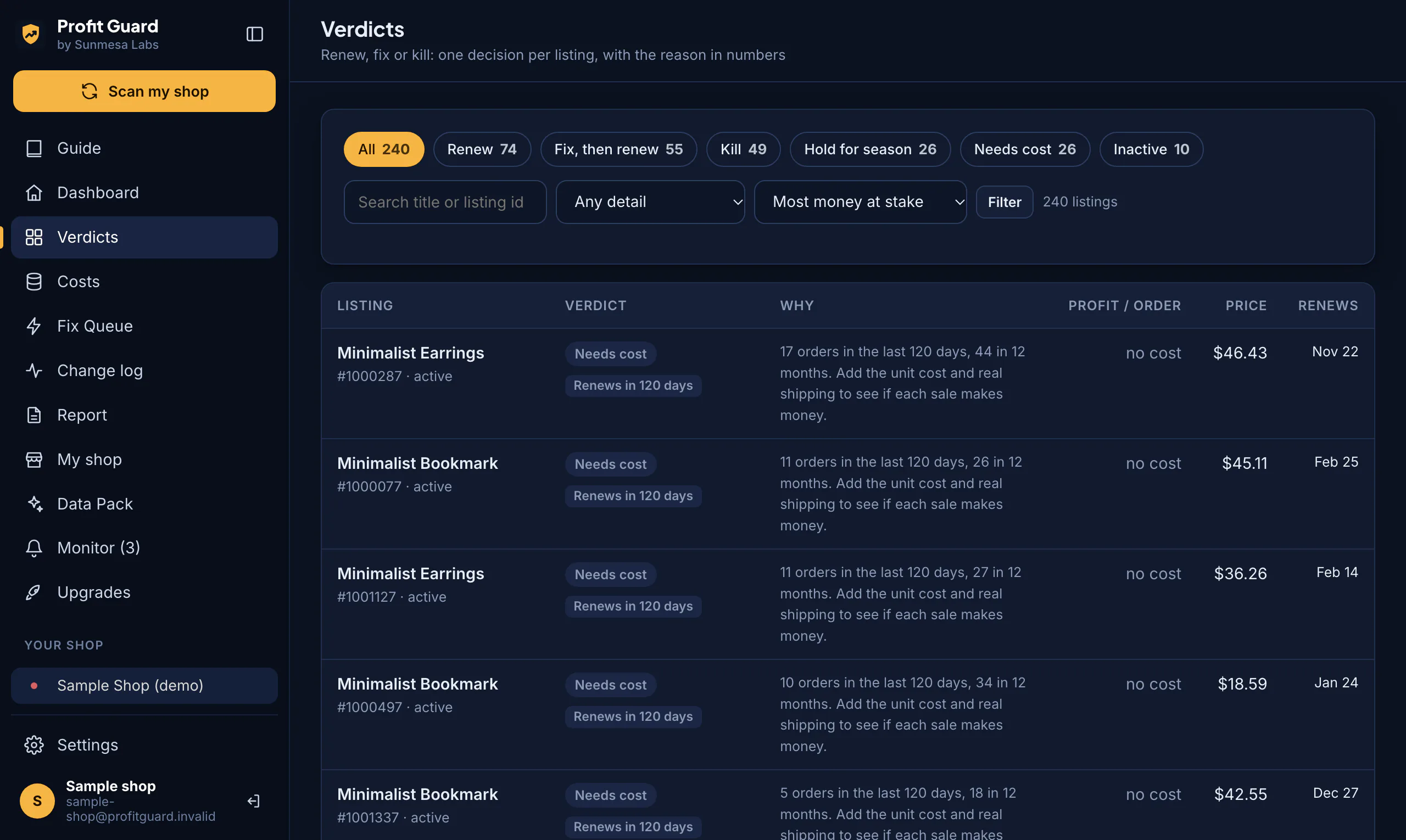
No black-box score. Each card below is a real verdict from the sample scan, word for word.
Keep paying the $0.20. This one earns it.
Fix the price or the listing before the next renewal.
Stop paying to renew it. Switch it off; it isn't deleted.
Don't kill it in July. Keep it for its season.
Add what it costs you and the verdict appears.
A listing is only marked Kill when three things are true: no sales for two renewal cycles, old enough to judge, and among the least-viewed in your shop. Listings with favorites or views get Fix, not Kill.
43 of the 49 Kill listings are still live. They have no sales and almost no views. The other 6 are expired or sold out. The live ones renew 3 times a year, and $7.40 of it falls due in the next 120 days. In a 1,000-listing shop with the same mix, that's about $108.
10 lose money on every order already, $215.38 lost on last year's orders. 11 more make a profit on a normal order and turn into a loss when the sale comes through Offsite Ads.
37 listings got a suggested price that reaches or gets closer to the 30% target, inside a 40% raise limit. That's the yearly difference if each sold as many orders as last year at the new price.
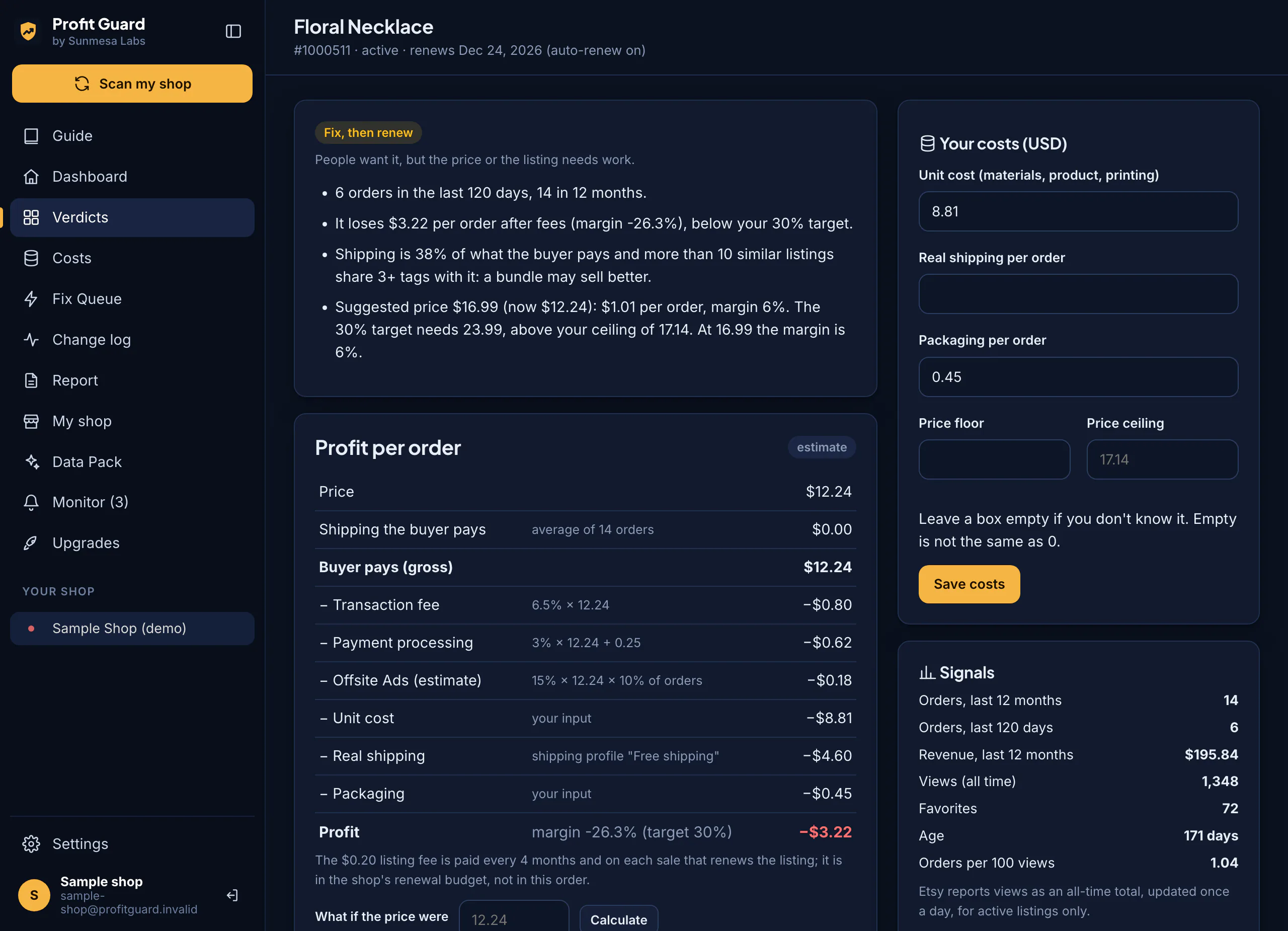
Every listing opens to its own calculation, line by line, plus a "what if the price were…" box. Sample shop data: made-up listings, real app output. Your numbers will be different.
One-time · 30-day money-back guarantee
Time estimates are ours, for a shop of about 250 listings, compared with doing the same work by hand in Shop Manager and a spreadsheet.
Every listing and 12 months of orders, read for you. By hand that's opening each listing's stats and copying numbers, a few minutes per listing.
The transaction fee is charged on price plus shipping. Payment processing follows your country, with the regulatory fee where Etsy charges one. Offsite Ads costs 12% or 15% on the share of orders you set. Conversion adds 2.5% when currencies differ.
Stop paying $0.20 three times a year for listings that never sell, and stop killing seasonal winners in the off season.
The lowest price that reaches your target margin after all fees. It's rounded to your price ending and kept between your floor and your raise limit.
How many listings renew in the next 120 days, what it will cost, and how many of them are Kill.
Sorted by sales, so the listings that matter come first. Download the CSV, fill it in Excel or Google Sheets, upload it back.
Cheap items where shipping is a big share of what the buyer pays, with similar listings that could go together in a bundle.
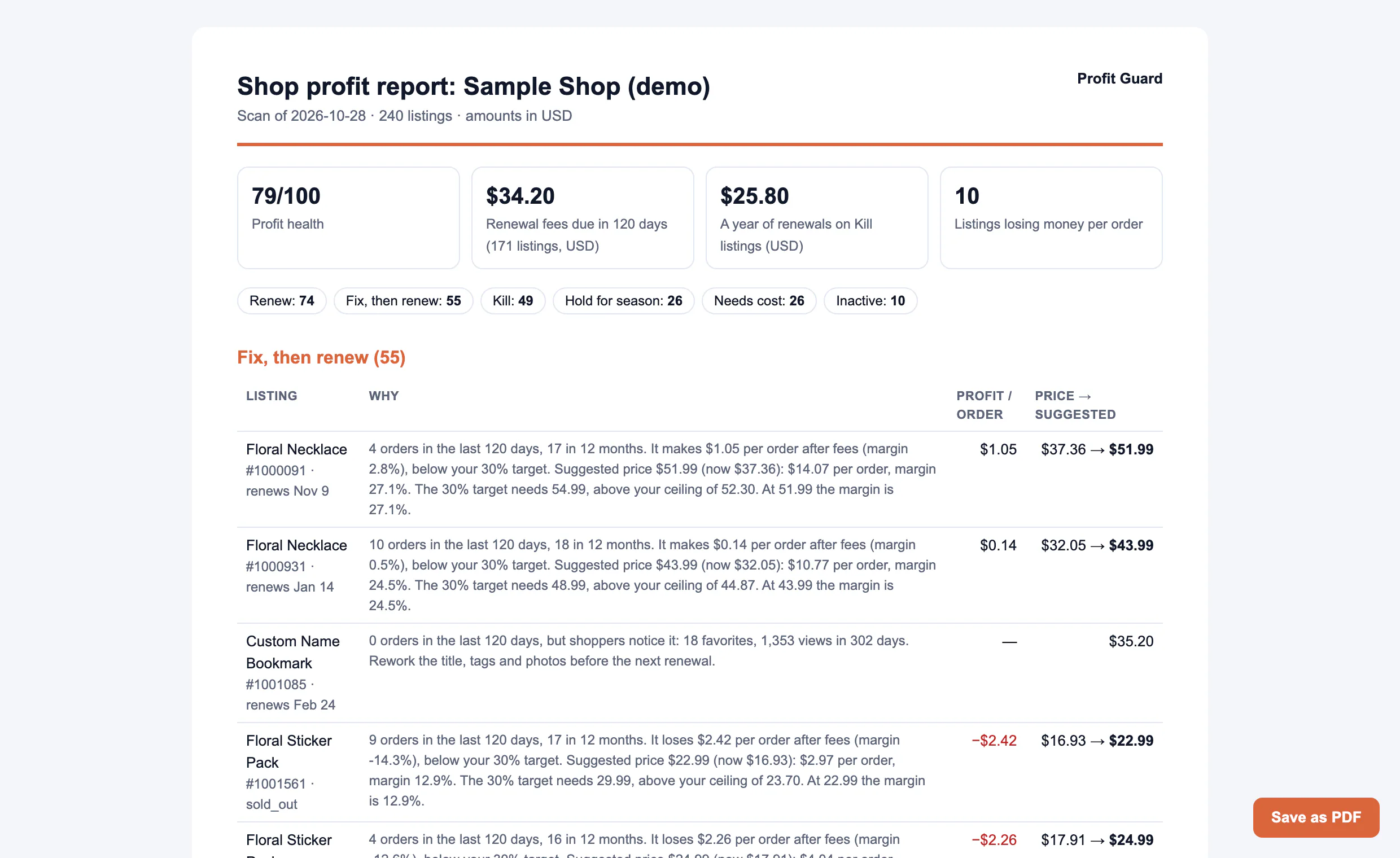
The PDF gives your health score and renewal budget, then every verdict with its suggested price. The CSV checklist puts fixes first, then kills.
The audit only readsA scan reads your listings and orders, plus your shipping profiles. It doesn't write anything to Etsy.
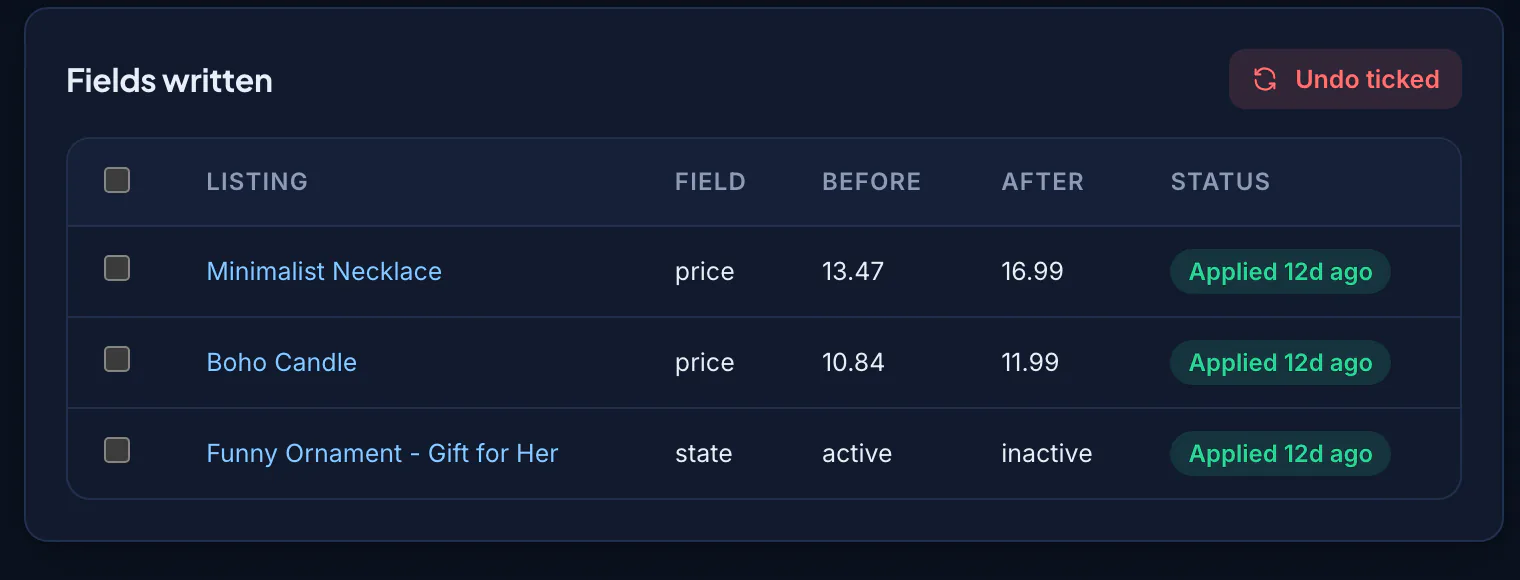
Approve-first, in batchesWith the Autopilot upgrade, every change waits in a queue with its before and after. Only the batch you approve is sent; any other write is refused by the app itself.
Re-reads the listing before writingChanged a listing on Etsy after the scan? Profit Guard sees it and skips that listing, so your edit stays.
Every change logged, with UndoEvery scan keeps a snapshot. Every field written is logged with the old value, and Undo writes it back.
Kill means switch off, never deleteA Kill listing is deactivated. Its photos and reviews stay, and so does its history. Renew it from Etsy whenever you like.
| Free spreadsheet / fee calculator | Reviewing by hand in Shop Manager | Profit Guard | |
|---|---|---|---|
| Reads every listing and 12 months of orders for you | one by one | ||
| Profit after all fees, per listing | one product at a time, typed in | No (revenue only) | |
| Offsite Ads and currency conversion included | if you remember | ||
| Renew / Fix / Kill decision with the reason | your gut feeling | ||
| Seasonal sellers protected from Kill | if you remember last December | ||
| Price that hits your margin (rounded, within your cap) | trial and error | ||
| Renewal budget for the next 120 days | |||
| Time for 250 listings | a weekend | 10+ hours | about an hour, mostly costs |
| Price | free | your time | $37 once |
General comparison of approaches, not of any specific product. Time figures are our estimates.
One blind renewal cycle of a 500-listing shop is already $100 (500 × $0.20). Profit Guard pays for itself the first time it stops one.
Value = our estimate of the hours each part saves on a shop of about 250 listings, at $15 an hour. Your time may be worth more.
You apply the changes yourself. Profit Guard gives you the verdicts and prices, in checklist order. You make the changes in Etsy. Prefer it done for you? Autopilot applies the changes you approve, and it's offered after checkout.
Get Profit Guard for $3730-day money-back guaranteeProfit figures are estimates built from your Etsy data and the costs you enter. Suggested prices are recommendations: you decide.
Connect your shop, add your costs, run the scan. Does Profit Guard show you at least one listing you'd stop renewing, or one price you'd change? If not, ask for a refund within 30 days and you get your money back. Ask through WarriorPlus or by email. The report you downloaded is yours to keep.
The fee side is calculated from your real Etsy orders and your country's fee rates. Every listing shows the calculation line by line, so you can check it. The cost side is as accurate as the costs you enter. Where a cost is missing, the listing says "Needs cost" instead of guessing. Results are estimates. Refunds and discounts can move a real order up or down, and so can gift wrap.
Etsy's API doesn't say which orders came from Offsite Ads, so Profit Guard doesn't pretend to know. You enter your Offsite Ads rate: 15%, or 12% if your shop made $10,000+ in 12 months. You also enter the share of your orders that came from Offsite Ads, which Shop Manager shows under Marketing. The fee is applied to that share, capped at $100 per order like Etsy does. Set it to 100% to see your worst case.
You log in on Etsy's own page and allow access; Profit Guard never sees your password. It asks to read your shop and its listings. It reads your orders and shipping profiles too. It also asks to update listings, which only happens for changes you approve with the Autopilot upgrade. The audit itself only reads. You can remove access at any time in your Etsy account settings.
One Etsy shop that you own. It stays tied to your account. Auditing client shops is the Agency Lite license, offered later in this order.
The audit changes nothing. If you add Profit Fix Autopilot, changes go to Etsy only in batches you approve, each one logged with an Undo. A Kill is a switch-off (inactive), never a deletion.
Yes. Profit Guard reads your shop's country and currency. It fills in the payment processing fee for many countries, plus the regulatory operating fee where Etsy charges it (UK, France, Italy, Spain, Türkiye). If your country has no preset, the app tells you so. Enter that fee from Etsy's fees page.
No. The Costs page lists your best sellers first, so the listings that make most of your revenue come first. You can fill a CSV in Excel or Google Sheets and upload it. Listings without a cost are still judged on sales and views, they just can't show a profit.
As often as you like. Each scan reads your whole shop again, up to 2,000 listings and 12 months of orders. Scan after you change prices or costs. Scan again before each 4-month renewal cycle to see your health score move. The optional Monitor upgrade runs those re-scans on a schedule and emails you when a listing slips into a loss.
No. The audit tells you what to change and in what order, with a suggested price where one is needed. You make the changes in Etsy, and the CSV checklist keeps track. Prefer to approve changes and have them sent to Etsy for you, each with an Undo? That's the Profit Fix Autopilot upgrade, offered after checkout.
Usually a few minutes; large shops take longer because Etsy limits how fast any app may read. You can close the page: the scan carries on and the results wait for you.
Digital listings are recognised and have no shipping cost. Listings with variations are scanned and judged; when a price change would need different prices per variation, the app tells you to set those by hand.
No. $37 once for your shop. Continuous monitoring is an optional yearly upgrade; you don't need it to use the audit.
Every 4 months the same listings renew, the same best sellers sell at a loss, and nobody checks. One scan shows you which ones. $37 once, 30 days to decide.
Scan my shop with Profit Guard: $37
Nothing changes in your shop unless you approve it · 30-day money-back guarantee
P.S. Do the sum before you close this page: your listing count × $0.20 × 3. Then ask how many of those listings sold anything this year. If you don't know, that's exactly what the scan tells you.
P.P.S. Do you help other Etsy sellers, or run more than one shop for clients? Shop owners pay agencies $97–197 for this kind of audit. After checkout you'll see an option to audit up to 10 client shops and hand them reports with your own brand on them.
Etsy renews every listing every 4 months, and its fees take a bite out of every order. Profit Guard shows you, listing by listing, which ones earn their $0.20 and which lose money, before the next renewal charges you again.
*Sample shop figure, if each listing sold as many orders at the new price as last year. Your numbers will be different.